

Elham Mousavi
Medically reviewed by Elham Mousavi, Aesthetic Medicine Specialist (IMG) — 26+ years in aesthetic medicine.

Thread Lift for Jowls is one of the most effective non-surgical treatments for improving jawline definition and reducing mild to moderate skin laxity. By lifting sagging tissue with dissolvable PDO threads, this procedure helps restore a firmer, more youthful facial contour without the downtime associated with traditional facelift surgery. In this guide, you’ll learn how thread lifts work, who is a good candidate, expected results, recovery, safety considerations, and the latest trends for 2026.
Here’s what matters most:
- Jowls are a structural problem: descended tissue, not just loose skin — which is why thread lifts (which physically reposition tissue) outperform topical treatments for this concern.
- Results unfold in two phases: an immediate mechanical lift followed by a 3–6 month collagen-building response as threads dissolve — results continue improving long after treatment.
- Cog (barbed) PDO threads are the primary tool for jowl lifting — their bidirectional anchors allow the practitioner to vector tissue upward and laterally along the mandibular border.
- Recovery is predictable: 5–7 days to social presentability, two weeks of light restrictions (no vigorous exercise, massage, or heat). Plan accordingly before scheduling.
- Ideal candidates are adults 35–65 with mild to moderate laxity who want natural, refreshed results — not dramatic transformation.
- Thread lifts are not right for everyone: significant skin excess (>2–3 cm) warrants surgical consultation; a qualified practitioner will tell you which category you fall into.
- Combination therapy amplifies outcomes: pairing threads with HIFU (for deep SMAS tightening) or dermal fillers (for volume restoration) consistently outperforms either treatment alone.
- Provider expertise is the most critical variable — thread placement is anatomy-dependent, and the angle, depth, and vector of each suture directly determines whether your result looks natural or overdone.
Read on for the full breakdown: procedure mechanism, recovery day-by-day, results timeline, candidacy criteria, and a clear comparison with fillers, HIFU, and surgery.
—
Introduction
You’ve probably noticed it happening gradually — the jawline that used to be more defined, a softness below the chin that wasn’t there in your 30s.
Jowls are one of the most common aesthetic concerns among adults 35–65, and one of the most resistant to topical products, massage, or exercise. That’s because they’re a structural problem — tissue that has physically descended, not simply skin that needs firming.
Thread lifts address jowls at the structural level — using fine, dissolvable sutures to reposition descended tissue and restore the clean mandibular border that made your jawline look defined.
The benefits go beyond the immediate lift:
- Visible results the same day — you leave the session with a noticeably improved jawline
- Progressive improvement over 3–6 months as collagen production builds around the dissolving threads
- Minimal downtime — most patients are social-ready within 5–7 days
- No general anesthesia, no incisions — performed under local anesthetic in a clinic setting
- 12–18 months of results, with a simple booster session available to extend
But thread lifts aren’t right for every patient or every presentation. Results depend enormously on provider expertise, thread selection, and honest candidacy assessment.
This guide covers everything you need to know: how the procedure works specifically for jowls, what realistic results look like on a timeline, how recovery unfolds day by day, and how thread lifting compares to HIFU, fillers, and surgery as alternative approaches.
At ELHAM AESTHETIC ART, jowl thread lifting begins with a careful assessment of your individual facial anatomy — not a standard package. What follows is what we want every patient to understand before walking into that consultation.
—
What Are Jowls and Why Do They Develop?
Thread Lift for Jowls is designed to improve one of the most common signs of facial aging: sagging tissue below the jawline. Jowls develop as the skin loses collagen, facial fat shifts downward, and supporting ligaments weaken, creating a heavier, less-defined mandibular border. Understanding why jowls form helps set realistic expectations and determine whether a thread lift is the right treatment for your goals.
The Anatomy Behind Jowling
Your jawline stays defined as long as three elements remain in balance:
- Skin elasticity — collagen and elastin holding the skin taut
- Facial fat compartments — positioned at the right depth and location
- Retaining ligaments — the connective tissue anchoring soft tissue to bone
As early as the mid-30s, all three begin to shift.
What Actually Causes Jowls
Collagen production declines at roughly 1% per year after age 25, softening skin’s ability to resist gravitational pull.
Facial fat doesn’t disappear — it descends. The cheek fat pads migrate downward and forward, collecting just below the mandibular border and adding to the appearance of jowling.
At the same time, the ligamentous structures that once held everything in place begin to stretch and weaken.
The Structural Reality
Volume in the wrong places. Definition where you don’t want it. A jawline that looks heavier and less balanced than it did a decade ago.
The good news: this is a structural problem — and structural problems have structural solutions.
Thread lifts address jowls at the mechanical level, repositioning tissue that has descended rather than trying to firm skin from the outside.
If you recognize yourself in this picture — a jawline that used to be more defined, a face that looks heavier than it feels — you’re likely an ideal candidate for a consultation.
—
How Thread Lifts Work on Jowls
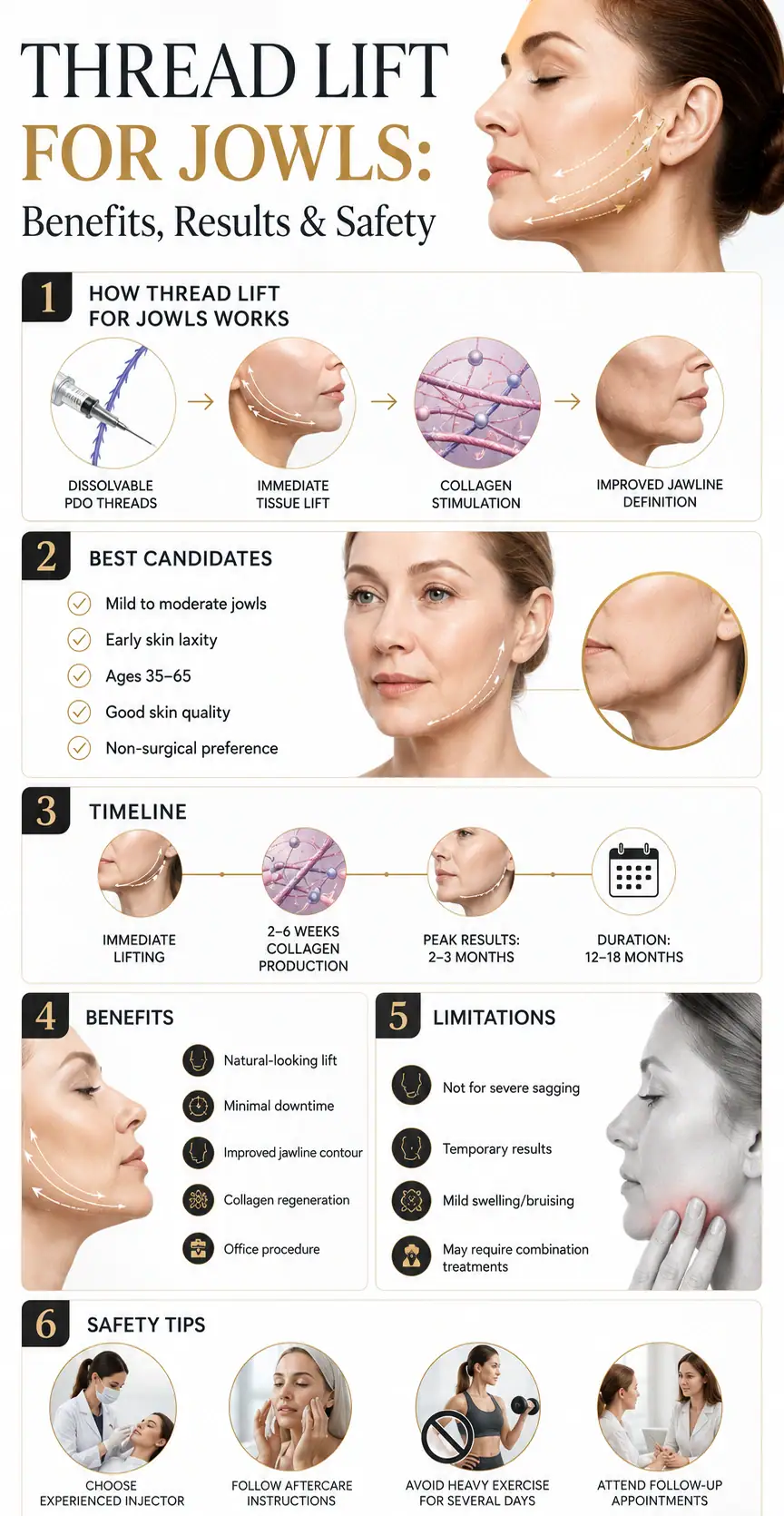
Thread Lift for Jowls works by repositioning sagging tissue with fine, dissolvable sutures placed beneath the skin. Rather than removing excess skin through surgery, the procedure gently lifts descended jowl tissue, restores jawline definition, and stimulates new collagen production for gradual, natural-looking improvement.
The threads used in a Thread Lift for Jowls are most commonly cog (barbed) PDO sutures. These specialized threads feature small bidirectional anchors that securely engage the tissue, allowing the practitioner to reposition the jowls while providing structural support as collagen forms around the threads during the healing process.
Placement and Mechanism
Once inserted, the barbs grip the soft tissue below the jowl and the practitioner vectors the thread upward and laterally — physically lifting the descended tissue back toward the cheek and jawline.
The effect is immediate: the mandibular border looks cleaner and more defined right after treatment.
Two Phases of Improvement
Thread lifts work on two overlapping timelines:
- Immediate lift — tissue is mechanically repositioned within the session
- Progressive collagen response — over the next 3–6 months, new collagen forms around the dissolving threads, adding structural support and skin firmness
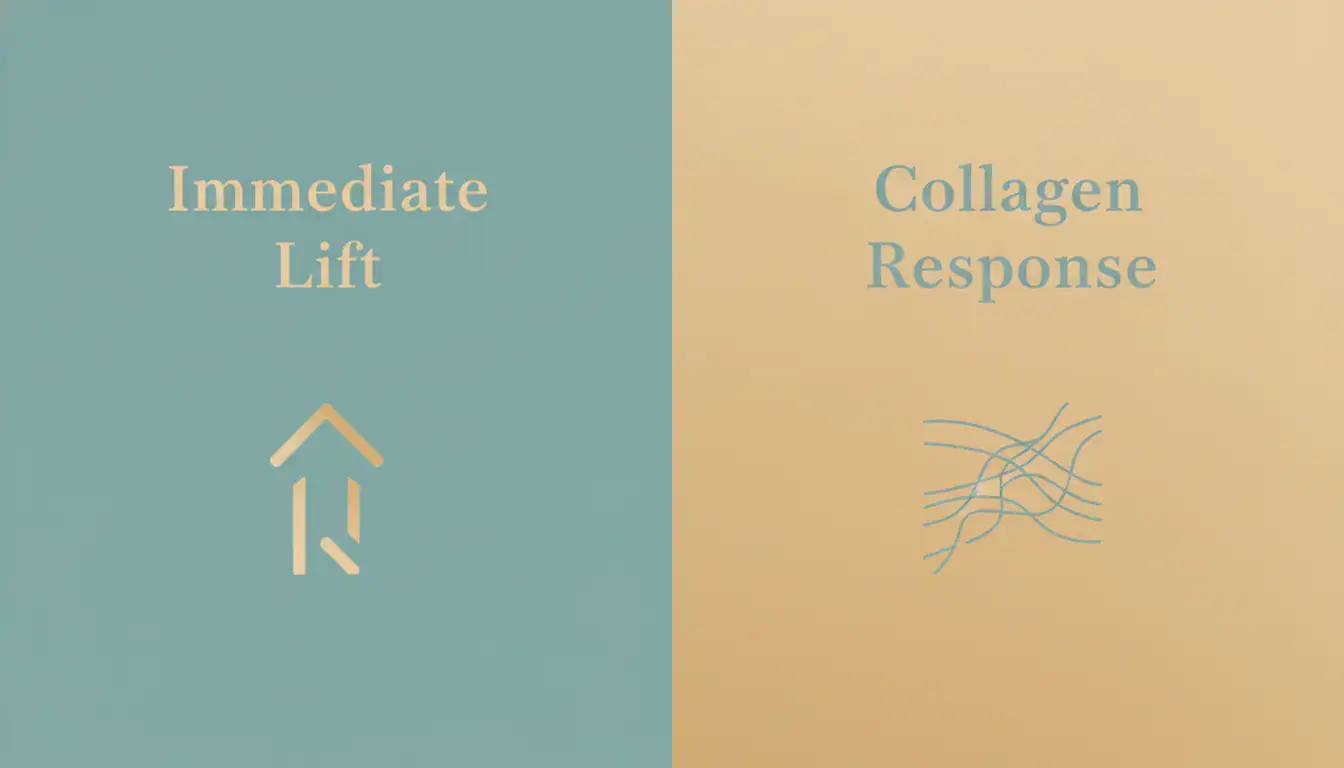
The result improves for months after treatment — which is why thread lift results look natural and progressive, not sudden.
Why Placement Expertise Is Everything
The angle, depth, and vector of each thread determines the outcome.
Jowl anatomy varies significantly between individuals — bone structure, fat distribution, skin thickness, and the degree of ligamentous laxity all affect how threads should be placed.
At ELHAM AESTHETIC ART, every thread lift begins with a careful assessment of your facial anatomy — identifying exactly where tissue has descended and which thread vector will reposition it most naturally.
Symmetry, balance, and a result that looks like a refreshed version of you — not a different face — starts at the assessment stage.
—
Benefits of Thread Lift for Jowl Reduction
Thread lifts have become the most requested non-surgical jowl treatment at aesthetic medicine clinics in North York and Toronto — and for consistent reasons.
Immediate, Visible Lift
You leave the session with a visibly improved jawline.
There’s no waiting 3–6 months for results to develop. The lift is visible same-day, with continued improvement as collagen production ramps up over the following weeks.
Minimal Downtime
Most patients are presentable within 5–7 days.
Compare this to a surgical facelift, which typically requires 3–6 weeks of recovery, and the practical advantage of thread lifting becomes clear — especially for patients with professional or social commitments.
No General Anesthesia. No Incisions.
The procedure uses local anesthetic only. There are no surgical incisions, no scalpels, no general anesthesia risk.
This makes thread lifting accessible to a much broader group of candidates than surgery — including patients with health conditions that rule out general anesthesia.
Collagen Stimulation as a Long-Term Bonus
Even after the threads dissolve (typically at 6–8 months), the collagen produced in response to them remains.
Skin quality, firmness, and texture in the treated area continue to improve for months — making thread lifts one of the few treatments that deliver both structural and quality improvements simultaneously.
Combination-Ready
Thread lifts pair exceptionally well with:
- HIFU — for deeper SMAS tightening beneath the thread level
- Dermal fillers — to restore volume in areas where jowling was worsened by fat descent
- Skin boosters — to improve skin hydration and surface quality
Combining treatments in a single session is an efficient, coordinated approach to comprehensive facial rejuvenation.
—
Pros and Cons: The Honest Picture
Choosing any aesthetic treatment requires a clear understanding of its benefits and limitations. Thread Lift for Jowls is highly effective within its clinical scope, providing a minimally invasive solution for mild to moderate sagging while enhancing jawline definition and stimulating natural collagen production. However, the procedure is not intended to replace surgical facelift techniques in cases of advanced skin laxity, making proper patient selection essential for achieving natural-looking, long-lasting results.
Pros
- Immediate, visible jawline improvement without surgery or general anesthesia
- Dual mechanism: mechanical lift now + collagen stimulus over months
- 5–7 day social downtime (vs. weeks for surgery)
- Natural, progressive results that don’t look sudden or overdone
- Combination-compatible with HIFU, fillers, skin boosters
- Results last 12–18 months with a booster session available to extend
Cons
Not every patient or presentation is appropriate for thread lifting. The honest caveats:
- Not permanent — results last 12–18 months; maintenance is required
- Not suitable for significant laxity — patients with more than 2–3 cm of redundant skin need surgical evaluation
- Provider expertise is critical — poorly placed threads produce dimpling, asymmetry, or visible suture lines
- Possible side effects: mild bruising, swelling, tenderness at entry points (typically resolving within 5–7 days)
The Expertise Equation
The safety and quality of thread lift results are inseparable from who performs the procedure.
An experienced Aesthetic Medicine Specialist assesses your anatomy, selects the appropriate thread type, and places sutures at the correct depth and vector for your specific face.
At ELHAM AESTHETIC ART, Elham Mousavi brings 26+ years of clinical experience to every thread consultation — with a philosophy rooted in honest assessment and natural, balanced results.
—
Thread Lift Results for Jowls: Timeline and What to Expect
Thread Lift for Jowls follows a gradual healing and collagen-building timeline rather than delivering its final outcome immediately. Understanding the treatment timeline helps you plan your procedure, set realistic expectations, and recognize when your jawline definition and lifting results reach their peak in the weeks and months after treatment.
What You’ll See Right Away
Within hours of your thread lift session, the jawline will look visibly lifted and more defined.
This is the mechanical lift phase — threads are anchored in position and tissue has been repositioned upward and laterally.
Mild swelling and tenderness at entry points are normal for the first 1–3 days.
The Collagen-Building Phase (Weeks 2–12)
As your body recognizes the dissolving threads and initiates a healing response, new collagen forms around and between the sutures.
This phase produces progressive tightening and skin quality improvement — results look better at 3 months than at 2 weeks.
Peak Results
Most patients see their best results at approximately 4–6 months post-treatment, when the collagen response is at its most active.
The jowl area will look:
- Lifted and repositioned
- Firmer in texture
- More defined along the mandibular border
- Refreshed — without the heaviness that prompted treatment
Duration
Thread lift results for jowls typically last 12–18 months. Individual duration depends on:
- Thread type and quantity used
- Skin laxity at the time of treatment
- Lifestyle factors (sun exposure, smoking, skin care routine)
- Whether combination treatments were used
A single booster session, typically at the 12–14 month mark, extends and refreshes results efficiently.
The Goal: Refreshed, Not Transformed
At your six-month follow-up, the change isn’t dramatic — but everyone who knows you says “you look great.” The jawline reads as cleaner, the lower face looks lighter, and the overall balance of the face is more harmonious.
That’s the standard: a refreshed version of yourself, not a different face.
—
Recovery After Your Jowl Thread Lift
Recovery from a jowl thread lift is manageable and predictable — one of the key reasons patients choose this approach over surgery.
Day-by-Day Recovery Timeline
Days 1–2: Mild swelling, bruising, and tenderness at entry points. Most patients describe it as pressure rather than pain. Cold compresses help reduce swelling.
Days 3–5: Swelling peaks and begins resolving. Some mild asymmetry during this phase is normal as swelling settles unevenly — this normalizes.
Days 5–7: Significant improvement. Most patients are comfortable in social situations at this stage.
Days 7–14: Continued settling. The final post-procedure appearance becomes clearer.
Week 3 onward: Collagen-building phase begins in earnest.
Restrictions for the First Two Weeks
To protect thread placement and avoid displacing sutures:
- No vigorous exercise — raises blood pressure and increases bruising and swelling
- No facial massage or pressure on the treated areas
- No saunas, steam rooms, or excessive heat
- Avoid sleeping face-down — sleep on your back with your head slightly elevated
- No dental procedures requiring wide mouth opening for 3–4 weeks
What to Expect at Follow-Up
Your practitioner will schedule a follow-up assessment at 2–4 weeks to evaluate thread positioning, symmetry, and early results.
Communicate any concerns early — minor asymmetries caught early can often be addressed while threads are still in their initial positioning phase.
Who Is the Right Candidate for Jowl Thread Lifting?
Thread Lift for Jowls is highly effective for the right candidates, but it is not the ideal solution for every degree of facial aging or skin laxity. Understanding the candidacy criteria helps you determine whether a thread lift aligns with your aesthetic goals, facial anatomy, and the severity of your jowls, ensuring realistic expectations and optimal treatment outcomes.
Ideal Candidates
Thread lifts for jowls work best for:
- Adults 35–65 with mild to moderate skin laxity
- Patients who have noticed early to moderate jowling — soft tissue that has descended, but not dramatically so
- Those seeking natural, refreshed results rather than dramatic transformation
- Patients who want to avoid the risk and recovery of surgery
- Individuals who prefer a personalized, assessment-led treatment over standardized protocols
The “Look Great, Not Different” Patient
The ideal thread lift candidate wants to look like a better version of themselves — not someone who has had work done.
If you’re looking for subtle, confident improvement — a cleaner jawline, a lighter lower face, more harmonious facial balance — thread lifting is likely a strong match.
When Thread Lifts Are Not the Answer
Honest candidacy assessment means acknowledging when threads are not appropriate:
- Significant skin excess (more than 2–3 cm of redundant tissue) — surgical correction is more appropriate
- Very thin skin — threads can become palpable or visible
- Active skin infection or inflammation in the treatment area
- Recent filler placed in the jowl area — coordinate timing with your practitioner
- Certain autoimmune conditions affecting wound healing
An experienced practitioner will assess all of these factors at consultation and recommend the most appropriate plan — which may include threads, alternative treatments, or a combination approach.
—
Thread Lifts vs. Other Jowl Treatments
Thread Lift for Jowls is one of several effective options for reducing sagging along the jawline. Understanding how a Thread Lift for Jowls compares with dermal fillers, energy-based skin tightening, and surgical facelift procedures helps you choose the most appropriate treatment—or the right combination—for your facial anatomy, skin laxity, desired results, and long-term aesthetic goals.
Thread Lift vs. Dermal Fillers for Jowls
Fillers and thread lifts address fundamentally different problems:
- Fillers add volume — replacing lost fat and structure in areas like the cheeks and temples
- Thread lifts reposition tissue — lifting what has descended below the mandibular border
For jowls caused primarily by tissue descent, thread lifting is more appropriate than filler alone.
Many ELHAM AESTHETIC ART treatment plans combine both: threads lift the descended tissue; fillers restore lost volume in the midface — achieving a more comprehensive result than either treatment in isolation.
Thread Lift vs. HIFU for Jowls
HIFU (High-Intensity Focused Ultrasound) targets the deep SMAS layer — the same structural layer addressed in surgical facelifts.
Key differences for jowl treatment:
Combining thread lifts and HIFU produces superior jowl results to either alone — threads handle the immediate visible lift while HIFU addresses deep structural tightening at the SMAS level.
Thread Lift vs. Surgical Facelift for Jowls
A surgical facelift remains the most comprehensive solution for significant jowling — but the gap between surgery and thread lifting has narrowed considerably.
Choose thread lifting when:
- Laxity is mild to moderate
- Downtime must stay under 2 weeks
- You want to avoid general anesthesia and surgical risk
Consider surgical evaluation when:
- Jowling is severe with significant skin excess
- You want permanent, long-lasting correction
- You’ve already had thread lifts and want more durable results
The right answer isn’t the same for everyone — it starts with an honest assessment of your anatomy, goals, and lifestyle at a qualified aesthetic medicine clinic.
—
Jowls are a structural problem — and thread lifts are a structural solution.
When performed with clinical precision and a genuine understanding of facial anatomy, thread lifts for jowls deliver one of the most rewarding outcomes in non-surgical aesthetic medicine: immediate lift, progressive collagen improvement, and a result that looks like a naturally refreshed version of you.
Here’s what to carry with you from this guide:
- Thread lifts work best for mild to moderate jowling — they reposition descended tissue rather than simply tightening skin
- Immediate lift + 3–6 month collagen response means results look better over time, not just right after treatment
- Recovery is real but manageable — plan for 5–7 days of social downtime and two weeks of light restrictions
- Candidacy matters — patients with significant skin excess may need surgical evaluation; honest assessment protects your outcome
- Combination therapy enhances results — HIFU, fillers, and skin boosters all complement thread lifting for more comprehensive improvement
- Provider expertise is the most important variable — thread placement is anatomy-dependent, and who performs the procedure directly determines your result
The best results don’t come from a standard package. They come from a practitioner who begins with your face, your anatomy, and your goals — and builds a plan around what will genuinely enhance what’s naturally yours.
At ELHAM AESTHETIC ART, Elham Mousavi brings 26+ years of internationally-trained aesthetic medicine expertise to every thread lift consultation — starting with the assessment that makes the difference between a natural result and an overdone one.
Ready to find out if a thread lift is right for your jowls? New clients receive 10% off their first treatment. Book your consultation today.
Ready to improve jawline definition without surgery? Learn more about our PDO Thread Lift procedure, candidacy, recovery, and expected results by visiting our Thread Lift Treatment service page to schedule a personalized consultation.
Conclusion
Thread Lift for Jowls offers a minimally invasive way to redefine the jawline, soften early to moderate jowls, and stimulate natural collagen production without the downtime of facelift surgery. While it is not a replacement for surgical lifting in cases of advanced skin laxity, it provides an excellent balance of immediate lifting and gradual skin rejuvenation for appropriately selected candidates.
The best results come from a personalized treatment plan based on your facial anatomy, skin quality, and long-term aesthetic goals. Choosing an experienced medical provider who uses high-quality PDO threads and follows evidence-based techniques is essential for achieving natural-looking, safe, and long-lasting outcomes.
If you’re considering this procedure, schedule a professional consultation to determine whether a Thread Lift for Jowls alone—or in combination with fillers, collagen stimulators, or energy-based treatments—is the most effective approach for restoring a youthful, well-defined jawline.
FAQs
1. What is a Thread Lift for Jowls?
A Thread Lift for Jowls is a minimally invasive cosmetic procedure that uses dissolvable PDO threads to lift sagging tissue along the jawline while stimulating collagen production for gradual skin tightening and facial rejuvenation.
2. How long does a Thread Lift for Jowls last?
Most Thread Lift for Jowls results last between 12 and 18 months, depending on your age, skin quality, lifestyle, collagen production, and the type of threads used.
3. Who is a good candidate for a Thread Lift for Jowls?
The best candidates for a Thread Lift for Jowls are adults with mild to moderate jowl sagging, good skin elasticity, and realistic expectations who want facial lifting without undergoing surgery.
4. Is a Thread Lift for Jowls painful?
A Thread Lift for Jowls is generally well tolerated. Local anesthetic is used to minimize discomfort, and most patients experience only mild pressure, soreness, or swelling for a few days after treatment.
5. How soon will I see results from a Thread Lift for Jowls?
You will notice an immediate lifting effect after a Thread Lift for Jowls, while collagen production continues to improve skin firmness over the following 6–12 weeks, with optimal results typically visible after two to three months.
6. Can a Thread Lift for Jowls replace a facelift?
No. A Thread Lift for Jowls is ideal for mild to moderate skin laxity, but it cannot provide the same degree of correction as a surgical facelift for patients with advanced sagging or significant excess skin.
7. Can a Thread Lift for Jowls be combined with other treatments?
Yes. A Thread Lift for Jowls is frequently combined with dermal fillers, collagen stimulators, skin tightening devices, or Botox to achieve more balanced, natural-looking facial rejuvenation.
8. What is the recovery time after a Thread Lift for Jowls?
Most patients return to normal daily activities within 24–48 hours after a Thread Lift for Jowls. Mild swelling, bruising, or tenderness usually resolves within one to two weeks.
9. Is a Thread Lift for Jowls safe?
When performed by an experienced medical professional using approved PDO threads, a Thread Lift for Jowls is considered a safe procedure with a low risk of complications. Following all aftercare instructions helps optimize healing and results.
For an evidence-based overview of absorbable sutures, collagen stimulation, and thread lift materials, see PDO thread on Wikipedia:
https://en.wikipedia.org/wiki/Polydioxanone