


Elham Mousavi
Medically reviewed by Elham Mousavi, Aesthetic Medicine Specialist (IMG) — 26+ years in aesthetic medicine.

Key Takeaways
Thinning hair rarely announces itself all at once — it shows up gradually, in a wider part or a slower-filling ponytail. PRP (platelet-rich plasma) therapy is one of the few non-surgical options with real clinical data behind it, and knowing what it can and can’t do is the first step to deciding whether PRP for thinning hair belongs in your plan.
- PRP uses your own blood platelets to deliver concentrated growth factors into the scalp, waking up weakened follicles for natural, gradual regrowth — no implants, no surgery.
- 70–80% of patients see visible improvement in hair density across published studies, with density gains typically in the 25–40% range after a full treatment series.
- Results follow a predictable timeline: reduced shedding by month 2–3, visible thickening by month 4–6, and full results between 6 and 12 months.
- PRP works on thinning hair, not bald skin — it strengthens follicles that are still alive, which is why treating early-stage thinning gets the strongest results.
- A typical plan is 3–4 monthly sessions, then a maintenance session every 4–6 months to hold the gains.
- The first 72 hours of aftercare matter: no hair washing for 24 hours, no intense exercise for 48–72 hours, and no NSAIDs like ibuprofen for a week.
- Candidacy is a medical decision — platelet disorders, active scalp infection, pregnancy, and certain medications rule PRP out, which is why treatment should start with a proper clinical assessment.
If you’re weighing PRP against waiting — or against more drastic options — the details below will help you make that call with clear expectations.
Introduction
Here’s a number worth sitting with: in clinical studies, roughly 7 to 8 of every 10 people who complete a PRP series see measurable improvement in their hair density. Not a miracle cure — a measurable, photographable change.
That distinction matters, because thinning hair attracts more overpromising than almost any other cosmetic concern.
PRP — platelet-rich plasma — takes the opposite approach. It doesn’t add anything artificial. A small sample of your own blood is concentrated into a platelet-rich serum and returned to your scalp, where its growth factors signal weakened follicles to re-enter their growth phase.
It’s the same “enhance what’s naturally yours” logic that guides every treatment we plan at Elham Aesthetic Art: work with your own biology, not against it.
In this guide, you’ll find:
- How PRP actually stimulates regrowth — and why it only works on living follicles
- The month-by-month results timeline, so you know exactly when to expect change
- What published research says about success rates and density gains
- How long results last, and the aftercare rules that protect them
If you’ve been watching your part widen and wondering whether it’s “bad enough” to act on — that question has a clinical answer, and it’s usually earlier than you think.
Here’s how the treatment works from the inside out.
How PRP Works on Thinning Hair
PRP stands for platelet-rich plasma — a concentrated serum made from your own blood, sometimes called plasma rich hair treatment.
The process is simple on your end.
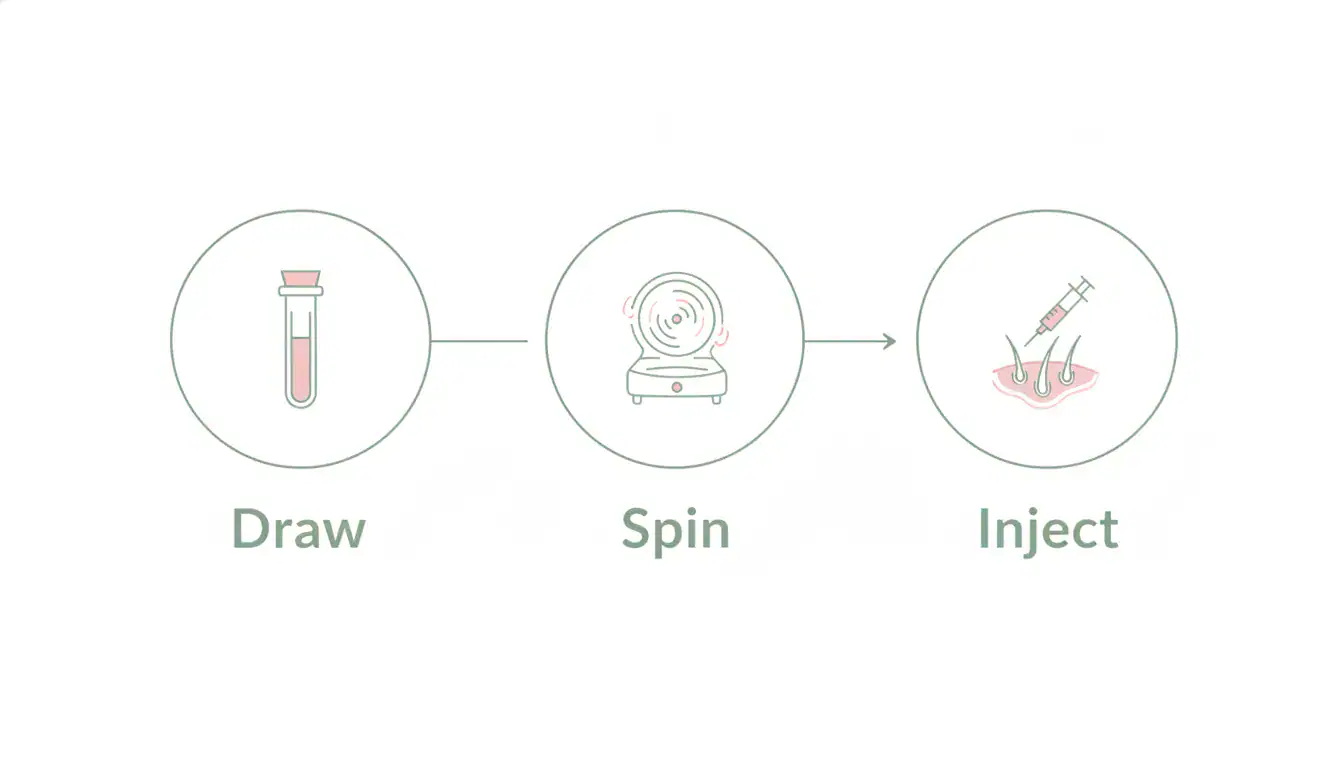
From Blood Draw to Follicle
- A small blood sample is drawn, just like routine lab work
- A centrifuge spins it to separate and concentrate the platelets — typically to several times their normal level
- The platelet-rich layer is injected in a grid pattern across the thinning areas of the scalp
The appointment usually takes 45–60 minutes, and most clients return to their normal day immediately.
Why Platelets Help Hair
Platelets aren’t just for clotting — they carry growth factors that signal tissue repair.
Injected at follicle depth, those growth factors do three things:
- Push resting follicles back into the anagen (growth) phase
- Improve blood supply around each follicle
- Thicken the hair shaft each follicle produces
The One Limit That Matters
PRP strengthens follicles that are still alive but underperforming. It cannot create new follicles where the scalp is fully bald and smooth.
That’s why the treatment is matched to thinning — and why acting while follicles are weakened, rather than gone, protects your options.
Who Sees the Best Results
PRP results aren’t random — the research is consistent about who responds best.
The Ideal Candidate Profile
You’re likely to respond well if:
- Your thinning is early to moderate — a widening part, lower density, more scalp showing under light
- The cause is androgenetic (male- or female-pattern) hair loss, the most studied use of PRP
- Your thinning areas still have hair, even if it’s fine or sparse
- You’re in good general health
Younger patients and those treating recent thinning consistently show stronger responses in studies — another reason early action pays off.
When PRP Isn’t the Right Call
PRP is a medical treatment, and a responsible provider screens for it. It’s generally not recommended if you have:
- A low platelet count or platelet dysfunction
- Blood or bleeding disorders, or you take blood-thinning medication
- An active scalp infection
- Chronic liver disease or severe anaemia
- Pregnancy or breastfeeding
Why Assessment Comes First
At Elham Aesthetic Art, every hair treatment plan starts with a personalized consultation — reviewing your scalp, health history, and the pattern of your thinning before anything is booked.
Twenty-six years of clinical experience has taught us a simple rule: the right candidate gets the right result. Screening isn’t a formality; it’s where good outcomes begin.
The PRP Results Timeline: Month by Month
PRP for thinning hair rewards patience — it works with your hair’s natural growth cycle, which moves in months, not days.
Weeks 1–4: Groundwork
Nothing visible yet, and that’s normal. Growth factors are active beneath the surface, but follicles need a full cycle to respond.
Some clients notice mild scalp tenderness for a few days after each session — it settles quickly.
Months 2–3: The First Signals
This is where most people notice the earliest changes:
- Less shedding on the pillow and in the shower drain
- Hair feels slightly stronger and less brittle
- Fine “baby hairs” may appear along the hairline or part
Months 4–6: Visible Change
The improvements become photographable:
- The part line looks narrower
- Density improves in treated areas
- Individual strands grow in thicker
Most published studies measure their headline results in this window — including a 2019 study in Dermatologic Surgery that found a 30–40% increase in hair density after three months of treatment.
Months 6–12: Full Results
With the initial series complete, results reach their peak between six and twelve months. This is when before-and-after photos tell the clearest story.
One quotable rule of thumb: judge PRP at month six, not month one. Anyone promising visible regrowth in weeks is selling, not treating.
Success Rates: What the Research Shows
“Is PRP hair treatment effective?” deserves a data answer, not a marketing one.
The Headline Numbers
Across published clinical studies:
- 70–80% of patients see visible improvement in hair density after a complete series — with some smaller studies reporting up to 85%
- Density gains typically land between 25% and 40%
- Measured increases average 25–30 additional hairs per square centimetre, with hair shafts 10–20% thicker
What “Success” Looks Like in the Mirror
Numbers aside, successful PRP typically means:
- A part line that stops widening — then narrows
- More coverage under bright light
- A ponytail or style that feels fuller
It does not mean a full head of new hair over bald areas. Honest expectations aren’t a disclaimer — they’re the difference between a satisfied client and a disappointed one.
Why Some People Respond Better
Response strength tracks with a few factors:
- Stage of thinning — earlier equals better
- Age — younger patients tend to respond faster
- Consistency — completing the full series, not stopping at one session
- Overall health — circulation, nutrition, and smoking status all influence follicle recovery
PRP’s satisfaction rates in studies run 70–85% — strong numbers for a non-surgical treatment, earned one follicle at a time.
How Long Results Last — and the Maintenance Plan
PRP is not a one-and-done treatment, and it’s better that you hear that before you book anything.
The Standard Treatment Rhythm
- Initial series: 3–4 sessions, spaced about a month apart
- Maintenance: a single session every 4–6 months after that
Why Maintenance Is Needed
PRP strengthens follicles — it doesn’t switch off the underlying cause of pattern hair loss. Without periodic top-ups, the gradual thinning process slowly resumes, typically over 9–12 months.
Think of it like fitness for your follicles: the results are real, and they last as long as the habit does.
How Long Do Results Last?
After a complete series, most clients hold their results comfortably with one to two maintenance sessions per year. At your consultation, your maintenance interval is tailored to how your hair responds — some clients need less, some more.
Stacking the Odds
PRP also pairs well with other approaches your provider may recommend — it’s frequently combined with topical treatments or used alongside microneedling for skin-level stimulation. The right combination depends on your pattern of loss, which is exactly what a proper assessment determines.
For the full picture of how PRP and PRF treatments fit together, our complete PRP & PRF guide covers the differences in depth.
Aftercare: What to Avoid After PRP
What you do in the first 72 hours after each session protects the investment you just made.
The First 24 Hours
- Don’t wash your hair — give the injection sites a full day
- Skip hats or headwear where you can
- Expect mild redness, tenderness, or small bumps at injection points — all normal, settling within 2–5 days
The First 72 Hours
- No intense exercise or heavy sweating for 48–72 hours
- No alcohol for 72 hours
- No saunas, steam rooms, or swimming for at least 2 days
- Stay out of direct sun for 3–5 days
The Full Week
Here’s the one most people miss: avoid ibuprofen, aspirin, and other NSAIDs for 7 days.
PRP works through a controlled inflammatory signal — anti-inflammatory painkillers blunt exactly the response you paid for. If you need pain relief, ask your provider what’s safe.
Also hold off for 3 days on:
- Minoxidil (Rogaine) or similar topicals
- Hair colouring or chemical straightening
One Simple Principle
For three days, treat your scalp like it’s doing important work — because it is. Gentle handling, no heat, no chemicals, no strain.
Your provider should hand you written aftercare instructions at every session. If a clinic doesn’t, that tells you something about the clinic.
PRP vs Other Hair Restoration Options
PRP isn’t the only tool for thinning hair — it’s the right tool for a specific job.
PRP vs Hair Transplant
The cleanest way to draw the line:
- PRP strengthens follicles that are still alive — best for early-to-moderate thinning
- Hair transplant relocates follicles into areas that are permanently bald — surgery, with surgical costs and recovery
Transplants typically run $4,000–$15,000+, against PRP’s per-session pricing (we break down full Canadian pricing in our PRP cost guide). Many advanced-loss patients ultimately use both — a transplant for coverage, PRP to strengthen everything around it.
PRP vs Topicals Alone
Minoxidil and similar topicals can slow loss, but they work only while applied daily and act at the surface. PRP works at follicle depth, in a handful of sessions per year — and the two can be combined under medical guidance.
The Honest Decision Rule
- Thinning but not bald → PRP is worth a consultation now
- Smooth, fully bald areas → PRP alone won’t regrow them; discuss transplant options
- Not sure which you are → that’s precisely what an assessment answers
Whichever route fits, the principle stays the same: start from an honest medical evaluation of your scalp — not a one-size-fits-all package.
Conclusion
Thinning hair is one of the few cosmetic concerns where waiting actively works against you — every month of untreated thinning is time in which weakened follicles drift closer to dormancy. The encouraging flip side: caught early, those same follicles respond, and the data says most people who complete a PRP series see real, measurable change.
What to hold onto from this guide:
- PRP for thinning hair is evidence-backed, not hype — 70–80% of patients improve, with density gains of 25–40%
- The timeline is 6–12 months, with the first visible changes around month 2–3
- It only works on living follicles — early action gets better results than late action
- Aftercare protects results — especially the no-NSAIDs rule most people have never heard of
- Candidacy is medical — proper screening comes before any needle
Your next step is simple: have your scalp properly assessed. Bring your questions, your health history, and if you like, a photo of your part from a year ago — the comparison often answers the “is it really thinning?” question on the spot. You can see how a course is planned and delivered on our PRP and PRF treatment page for Toronto and North York.
At Elham Aesthetic Art in North York, every PRP plan begins with a personalized consultation with Elham Mousavi, Aesthetic Medicine Specialist (IMG), drawing on 26+ years of experience in aesthetic medicine across Iran and Toronto. The goal is never a different you — just a fuller, healthier version of what’s already yours.
Book your consultation today — message us on WhatsApp at +1 (416) 843-8744 or visit elhamaesthetic.com. New clients save 10% on their first visit.
Your follicles are still listening. The best time to speak to them is while they are.